
Claude Code memory that survives the session, the tool and the model.
Start where you left off.
Claude Code memory has two built-in layers: CLAUDE.md files you write, and auto memory Claude writes for itself into a per-repository MEMORY.md. Both are plain Markdown, loaded at session start, and stay on one machine inside one tool. Vodou adds a third layer with four Claude Code hooks: memory from a local SQLite database is injected at SessionStart and on every UserPromptSubmit, a PostToolUse guard protects your files, and SessionEnd extracts what the session learned. The same memory reaches Cursor, Codex, Claude Desktop and any MCP client — and the ChatGPT or Claude tab in your browser.
- Vodou gives Claude Code persistent memory through four hooks — SessionStart, UserPromptSubmit, PostToolUse and SessionEnd — installed by writing .claude/settings.json.
- Vodou's hook binary is a zero-thread executable under 500 KB that talks to the Vodou daemon over a Unix socket and never opens the memory database itself.
- Vodou renders a fresh MEMORY.md per session and project from a local SQLite database with full-text and vector search, instead of a hand-maintained 200-line file.
- Vodou's memory is the same one Cursor, Codex, Claude Desktop, VS Code and 22 AI chat sites read — the model and the tool change; the memory doesn't.
What is Claude Code memory?
Claude Code memory is the set of mechanisms that carry knowledge across sessions, because each session starts with a fresh context window: CLAUDE.md files you write at managed, user, project and local scope, and auto memory — notes Claude writes itself into a per-repository MEMORY.md index plus topic files. Vodou adds a hook-driven memory layer on top of both.
The two built-in systems, as Anthropic documents them:
CLAUDE.md files
- Who writes it
- you
- What it holds
- instructions and rules
- Where
- ./CLAUDE.md, ./.claude/CLAUDE.md, ./CLAUDE.local.md, ~/.claude/CLAUDE.md, managed policy path
- Scope
- project, user or organisation
- Loaded
- every session, in full (up to 4 MiB)
- Control
- edit the file; /memory; /context shows what loaded
Auto memory
- Who writes it
- Claude
- What it holds
- learnings: user, feedback, project, reference
- Where
- ~/.claude/projects/<project>/memory/MEMORY.md + one topic file per memory
- Scope
- per repository, shared across worktrees, machine-local
- Loaded
- every session — the first 200 lines or 25 KB of MEMORY.md; topic files on demand
- Control
- /memory toggle, autoMemoryEnabled, CLAUDE_CODE_DISABLE_AUTO_MEMORY=1
Both are treated as context, not enforced configuration, and both are files on one machine. Auto memory is "not shared across machines or cloud environments", and Claude Code reads CLAUDE.md, not AGENTS.md. Anthropic's advice is to keep CLAUDE.md under 200 lines and move procedures into skills or path-scoped rules — the ceiling is deliberate, because everything loaded costs context tokens.
Why does Claude Code memory matter?
Every Claude Code session starts empty; the built-in memory closes part of that gap but only inside Claude Code, only for this repository, only on this machine, and only for the first 200 lines of MEMORY.md. The correction you gave in Cursor, the decision you made in ChatGPT and the preference you set in Claude Desktop never arrive. Vodou puts one memory under all of them, on your machine.
A file, not a search
MEMORY.md is an index Claude keeps short by hand; anything past 200 lines or 25 KB is dropped at load. Facts that matter today were pruned last week.
Per tool, per repo, per machine
Auto memory lives under one project directory in ~/.claude; Cursor, Codex and your browser chats have no view of it.
Memory written by the model, unreviewed
Claude decides what to save. Nothing shows you why a memory came back or lets you say “that one is wrong, everywhere”.
How does Vodou give Claude Code persistent memory?
Vodou's installer registers four hooks in .claude/settings.json; a small hook binary forwards each event to the Vodou daemon over a Unix socket, which searches a local SQLite memory and hands back the relevant facts as additional context.
- STEP 1
Install the hooks.
install.sh writes .claude/settings.json for Claude Code and .cursor/hooks.json for Cursor with the absolute path already filled in; vodou-core mem setup (or --global for ~/.claude/settings.json) does the same by hand. The hooks call vodou-hook-bin, a zero-thread binary under 500 KB with no database access; it talks to the daemon over a Unix socket and buffers if the daemon is down.
- STEP 2
Four hooks, four jobs.
SessionStart loads the workspace bootstrap and a rendered MEMORY.md (synchronous, 15 s budget). UserPromptSubmit sends the prompt to the daemon, which searches memory and returns prompt-targeted chunks that Claude Code injects as additional context — on every turn, not just at start. PostToolUse runs a NUL-byte guard after every Edit or Write and blocks a file that would break grep and tsc. SessionEnd triggers extraction from the transcript, asynchronously, so the IDE never waits on it.
- STEP 3
Render, don't hand-maintain.
MEMORY.md is a snapshot rendered from memory.db — pinned facts first, then project, then global — refreshed by the daemon about every 60 seconds and re-rendered per project at session start. Edits to the rendered file are overwritten; you pin, correct or reject memories in the Vodou Console or with vodou-core mem pin, and the next render carries the fix into every tool.
- STEP 4
The same memory everywhere else.
Cursor gets the bootstrap at sessionStart as JSON additional_context; Cursor does not inject hook output per prompt, so the daemon writes a context file the agent is told to read each turn. Codex in Cursor or VS Code reaches Vodou in Agent (Full Access) mode. Claude Desktop, VS Code, Windsurf and Zed attach through the MCP host with a vault per client. In the browser, the Vodou Bridge extension types the same memory into ChatGPT, Claude and 20 other sites with Ctrl+B.
Deep dive: MCP gateway · Browser extension
What can you do with Vodou's Claude Code memory?
Claude Code memory across sessions — on every prompt
The UserPromptSubmit hook searches memory for each prompt, so the fact you need arrives when the question is asked, not only in the first 200 lines at start.
Claude Code persistent memory in a real database
SQLite with FTS5 full-text search, vector embeddings and a cross-encoder reranker; a precision floor injects nothing rather than noise. Facts keep a source, a date and a trust weight.
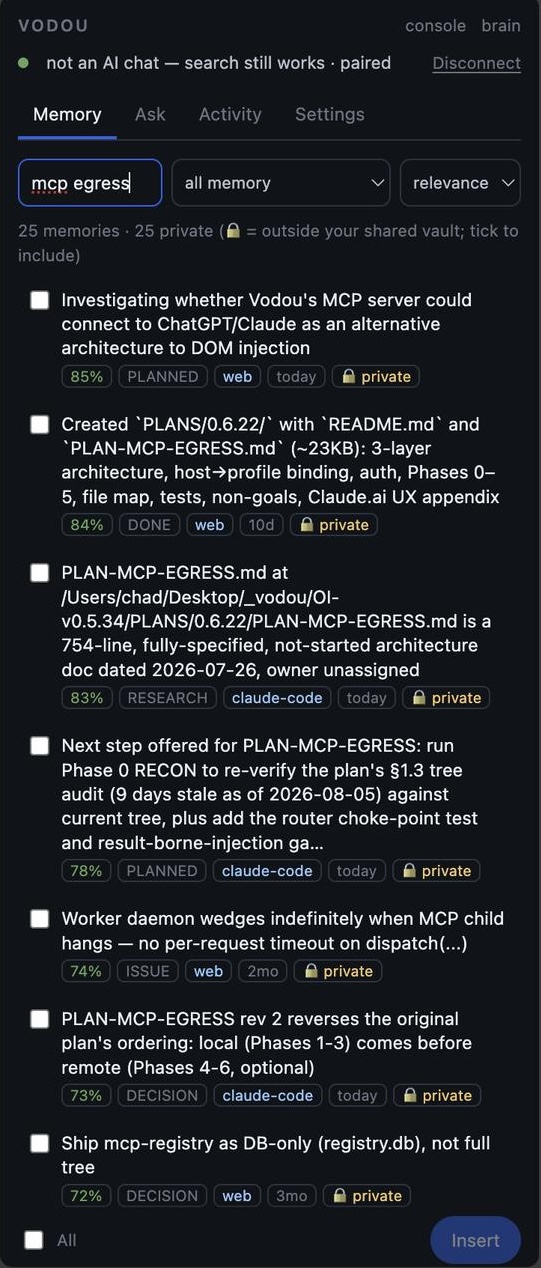
A Claude Code memory hook you can read
The hook config is four JSON entries; the binary has no threads and no database handle. docs/claude-code-hooks.md on GitHub documents every command.
Cursor memory between sessions
The same binary via .cursor/hooks.json: bootstrap at session start, a per-turn context file, extraction at session end. Cursor's own hook API is the limit, not Vodou's.
Claude Code memory in Codex and MCP clients
Codex in Cursor or VS Code uses Vodou in Agent (Full Access) mode; Claude Desktop, Windsurf and Zed attach through vodou-core mcp install <client> and read the vault you assign.
See why a memory was used, then fix it once
Every injected fact carries its provenance; vodou-core mem why or the Console shows which conversation it came from. Correct, reject, pin or undo it and every tool gets the fix.
Vodou helps me pick up where I left off without constantly re-explaining the context. I'm able to stay in motion and move my work forward much faster.
Sources Anthropic, “How Claude remembers your project” · Claude Code hooks reference · Cursor hooks docs · Vodou docs: claude-code-hooks.md
How does Vodou compare to Claude Code's built-in memory, Claude-Mem and Mem0?
Claude Code's built-in memory is free, on by default and needs nothing installed; Claude-Mem is a free, 94,000-star Apache-2.0 plugin that compresses tool observations into SQLite plus Chroma for Claude Code, Cursor, Codex and more; Mem0's Claude Code plugin keeps memory in Mem0's cloud and shares project memory across a team. Vodou's memory also comes from your browser chats and messaging apps and can run skills and tools — at $10 a month after 60 days, with a free account required.
| CAPABILITY | VODOU public alpha | CLAUDE CODE BUILT-IN | CLAUDE-MEM |
|---|---|---|---|
| What it stores | facts extracted from sessions, with source, date, trust weight | CLAUDE.md instructions + auto-memory notes Claude writes | AI-compressed “tool usage observations” + session summaries |
| Where | local SQLite memory.db (chmod 600) | Markdown under ~/.claude/projects/<project>/memory/, machine-local | local SQLite + Chroma; optional cmem.ai cloud mirror |
| Search | FTS5 + vector + reranker | none — first 200 lines / 25 KB of MEMORY.md loaded; topic files read on demand | FTS5 + Chroma vector (hybrid) |
| Injected when | session start and every prompt | session start | session start; MCP search tools on demand |
| Extraction | session end, async, by the model you pick, provenance kept | Claude decides during the session | Claude Agent SDK compresses at Stop; 5 lifecycle hooks |
| Works in Cursor | yes (session start + context file) | no | yes |
| Works in Codex / other agents | Codex (Agent Mode), MCP clients | no | OpenClaw, Codex, Gemini, Hermes, Copilot, OpenCode + more |
| Memory from browser chats (ChatGPT, Claude…) | 22 sites via Vodou Bridge | no | no |
| Memory from Slack, Telegram… | Unlimited (installable) | no | no |
| Shared with a team | no | CLAUDE.md via git; auto memory no | Team plan (cmem.ai) |
| See why a memory was used | yes, per retrieval | open the file | observation IDs + web viewer |
| Memory can run skills / tools | yes — unlimited skills and MCP servers | no | no |
| Adoption | public alpha | every Claude Code install | 94.1k GitHub stars |
| Price | $10/mo BYOK · 60-day free trial | included with Claude Code | free (Apache-2.0); CMEM Cloud $20/mo optional |
| Needs an account | yes (free; licenses the engine) | Claude account or API key | optional — installer asks for sign-in, skippable |
Sources checked (2026-09-17); competitor columns are as of that date.
- Claude Code built-in — code.claude.com/docs/en/memory
- Claude-Mem — github.com/thedotmack/claude-mem (README; Apache-2.0, 94,075 stars via GitHub API) · hooks architecture · cmem.ai (CMEM Cloud $20/mo, Team $333/seat/mo)
- Obsidian vault + MCP — github.com/MarkusPfundstein/mcp-obsidian (MIT, 4.4k stars, 7 tools) · obsidian-local-rest-api (MIT)
- Mem0 — Claude Code plugin (README + hooks/hooks.json, v0.3.1) · mem0.ai/pricing · mem0.ai/blog/claude-code-memory · mem0 PR #6530 (OpenMemory removed from the monorepo 2026-07-29; snapshot at mem0ai/openmemory) · mem0-chrome-extension (archived)
Vodou column: 4 hooks and 22 AI sites, checked against the product on 2026-09-17.
Frequently asked questions about Claude Code memory
How does Claude Code memory work?
Two ways, both documented by Anthropic: CLAUDE.md files you write are loaded at the start of every session, and auto memory lets Claude save notes about your preferences, corrections and project into a per-repository MEMORY.md plus topic files. Vodou adds a third: hooks that inject facts from a local SQLite memory at SessionStart and on every prompt, and extract new ones at SessionEnd.
Where is Claude Code memory located?
CLAUDE.md lives in your project (./CLAUDE.md, ./.claude/CLAUDE.md, ./CLAUDE.local.md) or your home directory (~/.claude/CLAUDE.md). Auto memory lives at ~/.claude/projects/<project>/memory/, with a MEMORY.md index and one file per memory. Vodou's memory lives in memory.db, a SQLite file in your Vodou workspace, and is rendered into a MEMORY.md for each project at session start.
What is the difference between CLAUDE.md and auto memory?
You write CLAUDE.md; Claude writes auto memory. CLAUDE.md holds instructions and rules for a project, your user profile or an organisation. Auto memory holds learnings — your role, corrections, in-flight work, external references — per repository, and only its first 200 lines or 25 KB load. Vodou sits under both: its hooks add a searched, provenance-tagged memory that is the same in Cursor, Codex and your browser.
Does Claude Code have persistent memory across sessions?
Yes — auto memory is on by default and carries notes between sessions of the same repository on the same machine; CLAUDE.md persists as long as the file does. What does not persist is anything outside that repo, that machine or that tool. Vodou's memory persists across all three: switch to Cursor, open ChatGPT, or start a new repo, and the same facts come back.
How do I give Claude Code persistent memory?
Turn on auto memory (it is on by default; check with /memory) and keep a CLAUDE.md in the project. For memory that is searched rather than truncated and that follows you into other tools, install Vodou: its installer writes four hooks into .claude/settings.json, and from then on relevant facts arrive on every prompt from a local SQLite database.
How do I disable Claude Code auto memory?
Run /memory in a session and toggle auto memory off, set "autoMemoryEnabled": false in ~/.claude/settings.json or a project's settings, or export CLAUDE_CODE_DISABLE_AUTO_MEMORY=1. Vodou's hooks are independent: you can keep auto memory off and still receive Vodou's memory, or remove the four entries from .claude/settings.json to stop Vodou.
Is there a Claude Code memory plugin?
Several. Claude-Mem (94,000+ GitHub stars, Apache-2.0) compresses tool observations into SQLite plus Chroma and works in Cursor and Codex too; smaller plugins add hybrid search or an Obsidian vault. Vodou is a memory layer rather than a plugin: four hooks in .claude/settings.json, a local SQLite memory that also comes from 22 browser AI sites and every messaging channel you connect, and skills and tools that act on it.
Does Cursor have memory between sessions?
Cursor does not ship a per-project auto memory like Claude Code's. With Vodou, Cursor gets the workspace bootstrap at sessionStart through its hooks API, a per-turn context file the agent is told to read (Cursor ignores hook output on prompt submit), and extraction at sessionEnd — all from the same memory.db Claude Code uses. The installer writes .cursor/hooks.json for you.
Can Claude Code memory transfer to Codex?
Not natively — auto memory is Claude Code's own directory. With Vodou the memory was never inside one tool: what Claude Code learned is in a local SQLite database, and Codex running in Cursor or VS Code in Agent (Full Access) mode reads it through Vodou, as do Claude Desktop and any MCP client. Vodou can also import existing ChatGPT, Claude and Obsidian exports.
More from Vodou
- AI memoryMemory you own that compounds with every session.
- AI harnessPlain English in, executed answer out.
- Agent harnessSkills, MCP, workers and hooks — already wired.
- Browser extensionYour chats, captured locally and typed back anywhere.
- AI orchestrationRoute before inference. Run tools together.
- SkillsWorkflows that run the same way every time.
- AutomationAgents that run unattended, within budgets you set.
- MCP gatewayOne MCP host for every editor on your machine.
- Local AI agentRuntime, memory and tools on your machine.
Start where you left off.
Install Vodou, let it write four hooks into .claude/settings.json, and give Claude Code, Cursor and Codex one memory they all read. Free for 60 days, no credit card.
Updated