
AI agent automation you can leave running — with budgets, approvals and a paper trail.
Owned. Everywhere. Acts.
AI agent automation is work an AI agent does without you in the loop for every step: reacting to an event, running on a schedule, or taking a task off a board and finishing it. Vodou runs all three on your own machine and wraps each in the controls a person needs before walking away — automations that fire only when a polled feed has something new, a scheduler that ticks every 60 seconds, a kanban board whose agents start with your memory pre-loaded and stop at a USD, token or runtime budget, and approval gates that reach you as buttons in Slack or Discord and as a numbered question in Telegram, WhatsApp, iMessage and any other channel you connect.
- Vodou automations trigger from polled MCP tool calls — including built-in event feeds for new captures, memories, contradictions, extraction failures and a JSON file — diffed by cursor, so nothing fires twice and a run with nothing new costs nothing.
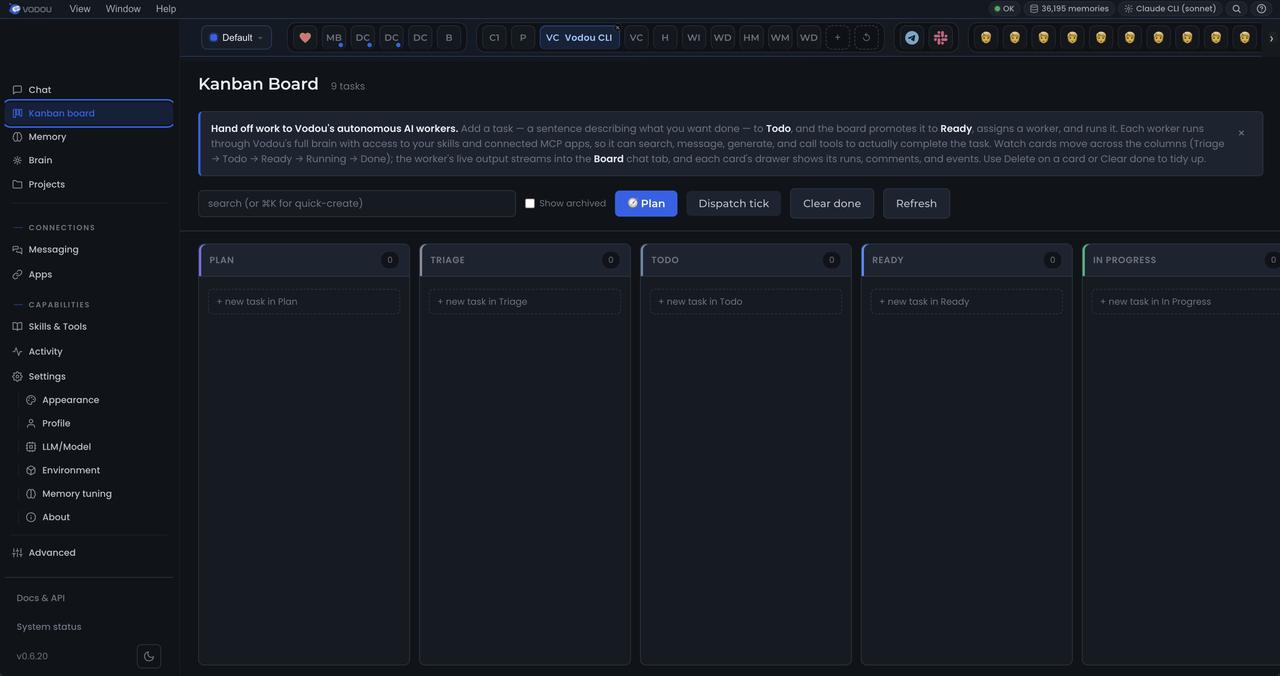
- Vodou's kanban board dispatches up to 3 agents at once, each pre-loaded with relevant memory and bounded by per-task USD, token and runtime budgets, controllable through the CLI, REST endpoints and MCP tools.
- Vodou approval gates suspend a task until you approve or deny it — with Slack Block Kit or Discord buttons, or a numbered reply in any messaging channel you connect.
- Vodou's proactive loops report capture gaps, stalled automations, extraction health and stale decisions, and a finding without evidence is rejected rather than stored.
What is AI agent automation?
AI agent automation is using AI agents to carry out multi-step work with little or no human intervention: an agent receives a goal or an event, chooses and calls tools, and finishes the job. Traditional automation follows rules written in advance; agent automation adds judgement — which is why it needs guardrails such as budgets and approvals. Vodou runs both kinds on your machine.
The explainers that rank for this phrase all draw the same line: a workflow runs a path you defined before it ran, an agent decides its own path. Both are useful, and the common mistake is to use one where the other belongs. Vodou keeps three lanes apart on purpose. Scheduled tasks and automations are deterministic — a trigger and an ordered chain of tool calls, no model in the loop unless a step is a skill. Workflows sit in between: you describe the job in a sentence, Vodou shows the plan, and nothing runs until you press Run once or Save + schedule. Board workers are autonomous within a budget: an agent takes a task, works it with tools, and closes it — or is stopped when its cap is hit.
Vodou runs on your machine and needs a free Vodou account so the engine can be licensed to you. With that in place, automations, scheduled tasks and the board live in local SQLite files, and the memory every worker starts with is your local memory.db — what leaves your computer is limited to the model calls and tool calls you configured — and a local model removes the first.
Why does AI agent automation need guardrails?
Because an agent that can send, post and spend will eventually do so at 3 a.m. without you. Rule-based automation cannot surprise you; an agent choosing its own steps can — a runaway token bill, an email that went out before the check, an automation that silently stopped three weeks ago. Vodou's board caps spend per task, holds outbound actions behind an approval, and watches its own loops so you hear about failures first.
Runaway spend
An autonomous worker retrying a broken step can burn a budget in minutes. Vodou sets soft and hard caps on USD, tokens and runtime per task, and the dispatcher terminates a worker that crosses one.
Irreversible actions
Sending, posting and deleting are the steps that cannot be undone. Vodou holds them behind a gate: a task suspends, you get Approve / Deny buttons in Slack or Discord (or a numbered question in Telegram, WhatsApp, iMessage, Signal, Teams, Google Chat, voice or web), and the audit trail records who decided.
Silent failure
Most automation tools tell you nothing when a job stops producing. Vodou's automations pause themselves after 10 consecutive failures and say why, and a proactive loop reports “this automation stopped producing” with the numbers.
How does Vodou automate AI agents?
Vodou lets you pick a clock or a feed as the trigger, hand the work to a budgeted board agent that starts with your memory, hold anything that leaves the machine behind an approval, and watch the whole thing with loops that report on evidence.
- STEP 1
Pick a trigger: a clock or a feed.
A scheduled task runs on cron, an interval or once, on a scheduler that ticks every 60 seconds and dispatches up to 2 tasks per tick. An automation polls an MCP tool on its own interval and acts only on new items: the first run seeds state and fires nothing, later runs diff by cursor, at most 5 events run per pass and the rest are deferred, never dropped. Every new event's fields are available as {{trigger.X}} in an ordered action chain, and a skill can be an action.
- STEP 2
Hand the work to a board agent.
vodou-core board create "<title>" --budget-usd 2 --budget-tokens 200000 --budget-runtime 900 --skill <name> puts a task on the board; the dispatcher (a 30-second tick) claims it atomically, spawns a worker with the top memory matches already in its prompt (board context <id> prints exactly which), and keeps at most 3 workers alive. The Plan drawer turns a plain-language goal into a dependency-chained task sequence, scoped to a codebase if you want the worker editing real files. Worker processes are opt-in: set VODOU_BOARD_REAL_SPAWN=1, and until then the board claims and plans tasks as a visible dry run.
- STEP 3
Hold anything outbound behind an approval.
A task with requires_approval_on suspends before it can complete; board pending lists it, board approve or board deny <reason> resolves it, and the same decision arrives as Slack Block Kit or Discord buttons whose signatures are verified before Vodou accepts them. Workflows get the same protection at compile time: a step that sends, posts or deletes is held behind an ask me gate that reaches every channel you use as a numbered question.
- STEP 4
Let the loops watch it.
Proactive loops run on the same scheduler and write to one findings table — capture-gap, automation-breaker, extraction-health, staleness and any loop added later. A finding must carry its numbers or it is rejected; loops write but never fix; a finding clears itself when the condition clears and expires after 30 days. vodou-core findings reads them, and the user-facing ones surface in your briefing.
What can you do with AI agent automation in Vodou?
An AI agent workflow builder that plans first
Say “every morning check my calendar and unread mail and write me a summary”; Vodou shows a plan card with the resolved server·tool per step, moves independent steps into a together: block (4.6× faster on one measured chain), and marks the join as need: 2 of 3. Run once or Save + schedule.
Schedule AI agents
Four payload types run on the clock: a brain query, a Skill Console skill, a single MCP tool call, or the heartbeat. Type /cron every weekday at 8 in a Skill Console tab and it is on the schedule.
An AI agent kanban board
Drag-and-drop columns at localhost:8765/#/board, a task drawer with runs, comments and events, workflow templates that advance a task's stage on completion, and board ask “what is blocked and why?” for a plain-language answer over the board's state.
Event-driven automations only Vodou can run
“When I decide something in ChatGPT or Claude, file it”: trigger feed_memories {tag: “DECISION”, scope: “capture:web:*”} → action linear.save_issue {title: “Decision: {{trigger.text}}”}. Or summarize every new web capture to a pinned console, or route open contradictions to a Slack webhook.
Budgets and approvals per task
board budget <id> sets caps, board budget report <id> shows caps against spend, workers self-report with board run-spend, and a task that crosses a hard cap ends with BudgetExceeded in its run history. Approval gates and their decisions are events on the task, so the audit trail is the board itself.
AI agent automation with n8n, GitHub Actions or your own scripts
The board's REST endpoints and the OpenAI-compatible API on 127.0.0.1:8765 let n8n or a CI job create tasks and read results; a script's JSON ledger can be a feed (feed_json_file), so a nightly hunt that writes leads becomes a trigger that only fires for new ones.
Instead of moving through everything one task at a time, Vodou helps me advance multiple projects in parallel. I'm getting more leverage from the same amount of time.
Sources Vodou docs: vodou-automations.md · Vodou docs: kanban-board.md · Vodou docs: proactive-loops.md · Slack Block Kit documentation · Discord interactions documentation
How does Vodou compare to n8n, Zapier Agents, Lindy and Make?
n8n, Zapier Agents, Lindy, Make and IBM watsonx Orchestrate are better choices for connecting hundreds of SaaS apps, for teams, and for webhook-driven flows — n8n lists over 500 integrations, Zapier over 9,000. Vodou is one person's automation on their own machine: unlimited MCP servers — any you add — no webhooks, no shared workspace. None of them states a per-task cap in dollars and tokens; Vodou has one, and loads your local memory into every worker run.
| CAPABILITY | VODOU public alpha | N8N workflow automation | ZAPIER AGENTS Zapier | LINDY AI agents | MAKE AI agents | IBM WATSONX ORCHESTRATE enterprise |
|---|---|---|---|---|---|---|
| Runs where | Your machine, loopback only | Cloud or self-host; “fully on-prem option” | Zapier cloud | Lindy cloud | Make cloud | IBM Cloud, AWS, on-prem |
| Integrations | Unlimited MCP servers + one-click app connectors | “over 500 integrations” (homepage); directory lists 2,177 | “9,000+ apps” | “1,000+” + MCP | “3,000+ apps” | Catalog of 60+ prebuilt agents, plus custom tools |
| Triggers | Polled MCP tools + event feeds; cron / interval / one-shot; no webhooks | Webhooks, schedules, app trigger nodes | Chat / on demand, schedule, app events, Zaps & MCP | Email, Slack, schedule, meetings, webhooks | Webhooks, mailhooks, schedules | Chat; schedulable workflows |
| Memory in every run | Yes — hybrid retrieval from your local memory pre-loaded into the worker prompt | Memory nodes (Simple, Postgres, Redis…), per session | Knowledge sources (files, apps); memory across runs not stated | Editable memory “in plain files” | Per-thread history via thread ID | Agent memory across conversations; view, edit, delete |
| Per-task budget (USD / tokens / runtime) | Soft + hard caps; worker terminated on breach | No USD/token cap; agent max iterations | Fixed cap: 10 (Free) / 40 (paid) activities per run; no USD/token cap | Plan credits; pauses when credits run out; no per-task cap | Agent timeout (300 s default, 600 s max); no USD/token cap | Not stated; plans capped by messages per month |
| Human approval | Slack / Discord buttons + numbered reply in every channel (unlimited, installable); workflow ask me gate | Per-tool approval via 9 channels (Slack, Discord, Telegram, Teams, WhatsApp, Gmail…) | Agent asks via a messaging app when told to; Human in the Loop step in Zaps | “Anything with outside impact waits for a named approver” | “Add manual approvals, or stop the Agent at specific points” | Human-in-the-loop approval steps in workflows |
| Visual canvas | No — plan card + recipe text; a builder view for skill actions | Yes | Copilot chat builder | Chat builder | Drag-and-drop + Maia | Yes |
| Reports its own failures | Proactive loops with evidence; circuit breaker after 10 failed runs | Execution log; error workflows (Error Trigger) | Activity tab marks failed runs | Errored tasks flagged; email alert | Email alert on unhandled errors; error handlers; incomplete executions | Observability of activity, policy and risk |
| Multi-user / shared workspace | No — single user | Yes | Yes | Yes | Yes | Yes |
| Code you can read | Gateway, skills, MCP servers Apache-2.0; engine proprietary | Fair-code (Sustainable Use) | Closed | Closed | Closed | Closed |
| Price | $10/mo BYOK after a 60-day free trial | Free self-host; cloud from €20/mo (Starter), execution-based | Agents: free 400 activities/mo; Pro ~$33/mo (annual), 1,500 activities | $29.99 / $99.99 / $199.99 per user per month, credits | Free plan (1,000 credits/mo, no time limit); Core $12/mo | 30-day trial; Essentials from $530/mo, Standard from $6,360/mo |
Frequently asked questions about AI agent automation
What is the difference between an AI agent and automation?
Automation follows rules you wrote in advance — a trigger and a fixed chain of actions. An AI agent is given a goal and decides its own steps, calling tools as it goes. Vodou has both: automations and scheduled tasks are deterministic tool chains, board workers are agents that plan and act within a per-task budget, and workflows sit between them — you see the plan, then press run.
Is ChatGPT an AI agent?
On its own, ChatGPT is a chat model: it answers when you type and stops. It becomes part of an agent when something around it can call tools, keep state and act on a schedule. Vodou is that something: it runs a model from any provider — including OpenAI models by your own key — inside board workers, scheduled tasks and automations, with memory, budgets and approvals around the model.
What are the best AI agent automation tools?
For teams connecting hundreds of SaaS apps, n8n (self-hostable, 500+ integrations), Zapier Agents (9,000+ apps), Make (3,000+ apps) and Lindy (agent-first, approvals) lead the roundups. For one person automating their own work on their own machine, with memory in every run and budgets per task, Vodou is built for exactly that and costs $10 a month with your own API keys after a 60-day trial.
How do I schedule AI agents?
In Vodou, open Activity → Scheduled → + New task and choose On a schedule (cron, an interval, or once) — the payload can be a brain query, a skill, one MCP tool call or the heartbeat. Or type /cron every weekday at 8 in a Skill Console tab, or say “every Friday post a project summary to Slack” and press Save + schedule on the plan card. The scheduler ticks every 60 seconds.
Can I run AI agent automation for free?
Vodou is free for 60 days with no credit card, then $10 a month on the BYOK plan, where you bring your own API keys and usage is never metered. Local models through Ollama, LM Studio or the bundled llama.cpp make a run cost nothing beyond electricity. A free Vodou account is required to license the engine; the automations, board and memory stay on your machine.
What is an AI agent kanban board?
An AI agent kanban board is a task board whose cards are worked by AI agents instead of, or alongside, people: a dispatcher claims a ready task, spawns a worker, and moves the card as the worker reports. Vodou's board does this with memory pre-loaded into each worker, at most 3 workers at once, per-task USD, token and runtime budgets, approval gates, and a CLI, REST endpoints and MCP tools to drive it. Worker processes are opt-in: set VODOU_BOARD_REAL_SPAWN=1, and until then the board claims and plans tasks as a visible dry run.
Can I use AI agent automation with n8n?
Yes, in both directions. n8n can call Vodou's board REST endpoints on 127.0.0.1:8765/api/board/* to create tasks and read results, or send a chat request to Vodou's OpenAI-compatible /v1/chat/completions and get an answer that used your memory and tools. Vodou cannot receive an n8n webhook — its triggers are polled MCP tools — so for n8n-initiated work, have n8n create a board task.
Does Vodou support webhooks as triggers?
No. A Vodou automation's trigger is always a polled MCP tool call, diffed against what it saw last time; there is no webhook receiver, file watcher or time-only trigger in automations (time belongs to the scheduler). Outbound is different: an automation can POST to a Slack, Discord or Zapier webhook when it fires, and board notifications can target any webhook URL.
More from Vodou
- AI memoryMemory you own that compounds with every session.
- AI harnessPlain English in, executed answer out.
- Agent harnessSkills, MCP, workers and hooks — already wired.
- Browser extensionYour chats, captured locally and typed back anywhere.
- AI orchestrationRoute before inference. Run tools together.
- SkillsWorkflows that run the same way every time.
- MCP gatewayOne MCP host for every editor on your machine.
- Local AI agentRuntime, memory and tools on your machine.
- Claude Code memoryMemory in Claude Code, Cursor and Codex on every prompt.
Hand it the work. Keep the say.
Put a task on the board with a budget, hold the send behind an approval, and let Vodou run it on your machine while you do something else. Free for 60 days, no credit card.
Updated